
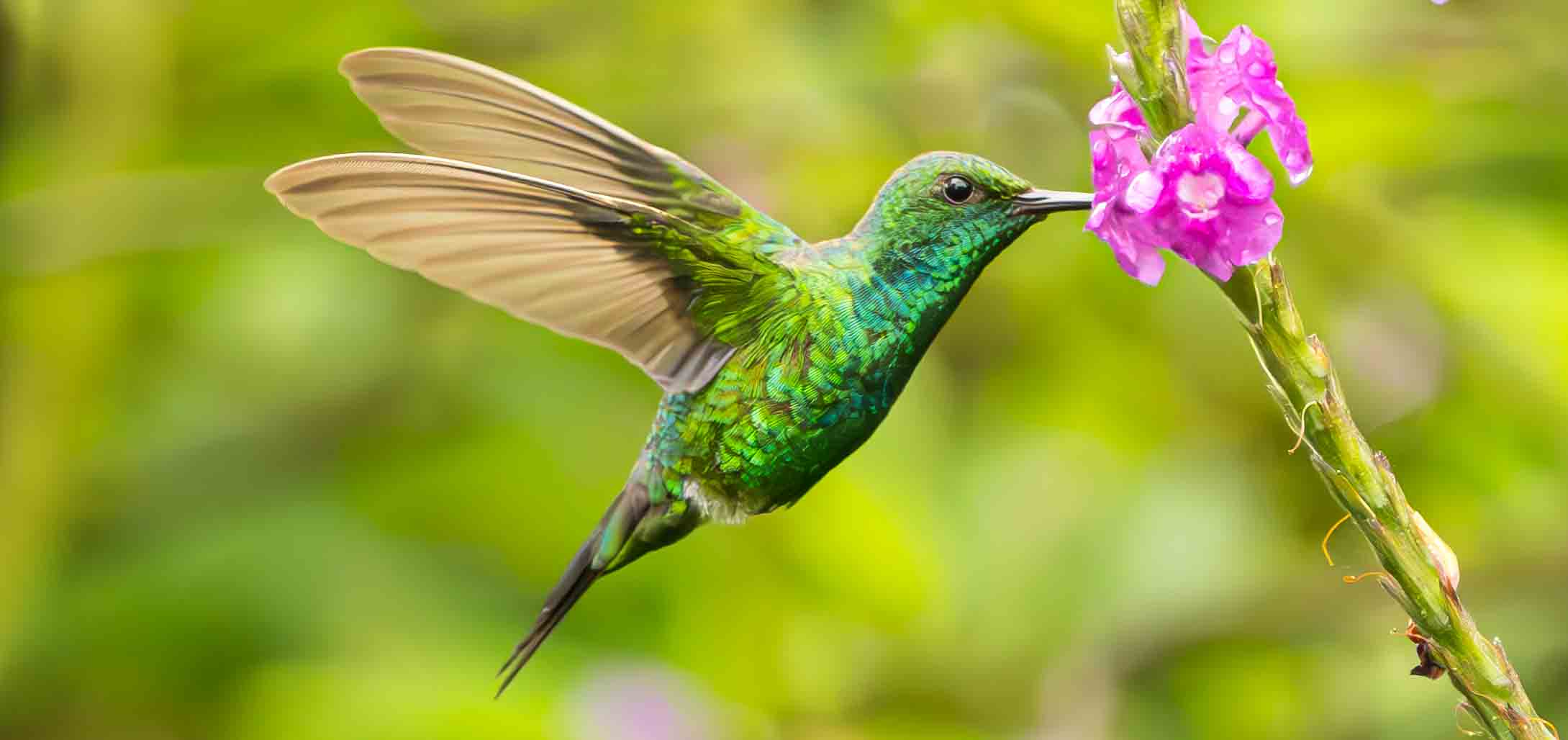


Among the first birds we saw in Costa Rica was a Rufous-tailed Hummingbird, which turned out to be a kind of ringmaster for the circus to come. Whenever we spotted these green and orangish-brown birds, they’d be racing about, slamming into competitors, running the show.

That was just the beginning of a visit to a part of the world where hummingbirds are as common as sparrows, 53 species in a country the size of West Virginia. They range from the Scintillant, not much bigger than an insect, to the Violet Sabrewing, deep blue bird up to six inches long.
For those of us who grew up watching a single species or two, this is a hummingbird candy-store. They come in a vast spectrum of colors, some of which don’t seem to exist in the rainbow — shimmering, neon-like patches of green, purplish reds and deep speckled blues.

Here are just a few of the hummingbirds we came across:


What strikes you about this narrow stretch of terrain that separates the Pacific Ocean from the Gulf of Mexico, with mountains rising as high as 12,000 feet, is how hummingbirds span the beaches to jungles, and cities to forests. They’re drawn to the flowers and buds for nectar, of course, but also roam the fields and trees from the lower rainforests to high around the country’s many volcanoes. Indeed, that’s where we kept running into the light-brown, frenetic buzzing of the Volcano Hummingbird.

Here are some of our most popular hummingbird posts from over the years. This one from last spring explores the frenzy right before migration. And this one looks at the famous infighting that helps define hummingbirds. This last is about the remarkable hummingbird mechanics that enable them to fly backwards and forward and reach impressive speeds.

After a while you pick up on some distinct personalities. The Rufous-tailed is among the most aggressive, chasing away competitors even though there’s plenty of territory to go around. “The bully,’’ one guide called them. “The boss,’’ another said.

The Violet Sabrewing, among the largest in the world, is also a domineering figure. Its deep blue form can be seen lording over its territories. We loved watching the smaller, more timid species working around these bosses to find their fill.
We spent nearly two weeks on this visit last year looking for all kinds of birds among Costa Rica’s 900 species. Of them all, the hummingbirds kept turning our heads, sometimes because they buzz right up to you – apparently not too small to take on a tourist that gets in their way.
As a photographer, it’s impossible not to be drawn by their constant, high-energy antics. They spent half their time buzzing in search of food, mostly nectar plus a few insects during breeding season. Otherwise they preen, (a daily process of cleaning, oiling and realigning each feather), or rest for another round at the flowers. At night, they sleep.
My passion is to catch hummers in flight. Their a breathtaking speed of up to 80 wingbeats per second can really work against you. (That adds up to more than 4,000 wingbeats per minute.) As one fellow photographer put it, “I have hundreds of photos of where the hummingbird used to be.’’


But when you do manage to pull off a stop-motion moment, their magnificent feathers turn out to be even more astounding. Wings become a blur, but tail feathers spread out like fans to reveal even more colors. Hummers with long tails flip them around like flags.
It’s one way to get a glimpse of these birds in all their glory, in a place that can support an entire circus. By the time we headed home, we’d only seen about half of Costa Rica’s hummingbirds. Looks like we’ll need to venture back to search for the rest.
Note: We’re rerunning this post from about this time last year while we’re in the midst of a move from Raleigh to Nashville, which us keeping from doing as much birding as we like. We hope to get back to chasing the migration later this spring, and as always will share what we find and the lessons from the wondrous world of birds.


Leave a Reply