
By Beverly and Anders Gyllenhaal
All warblers are wonderful to watch, most especially males in the spring. Nature gives them fresh feathers, all the better to snare a mate. For some warblers, spring markings and colors intensify to the point that they look nothing like their normal selves.

Our favorite, by a long shot, is the Prothonotary Warbler.
So it was a special gift this past weekend when we got out birding for the first time in many months and that singular flash of bright yellow zipped across the lower branches of a tree like an invitation to springtime migration. It was a Prothonotary welcoming us back to the birding trail.
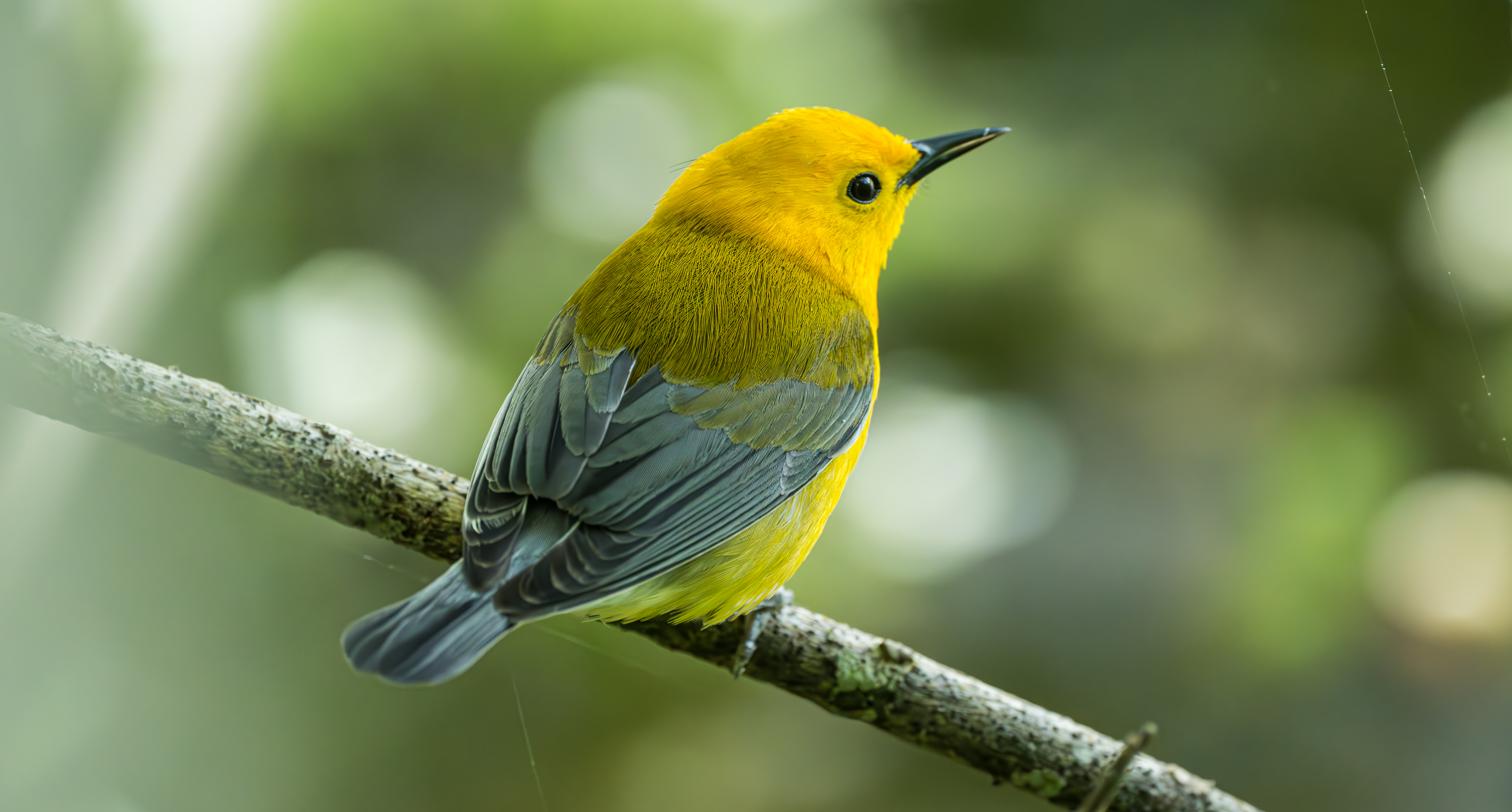
Of the 37 warbler species in the Eastern U.S., the male Prothonotary is the only one that literally glows. His head is a saturated yellow-orange, earning him the nickname “Golden Swamp Warbler.”
Finding a Prothonotary feels like discovering that last, hopelessly hidden Easter egg. You have to see it to fully appreciate it, and every time, he takes your breath away.
This most recent visit was especially delightful. We’re in the midst of a move from Raleigh to Nashville, which has pushed birding far down the list of activities. It’s tormenting to watch the BirdCast numbers that track the millions of migrating bird passing over each night and be unable to get out to chase them.

It was a perfect day to chase birds: Temperatures in the mid-70s, sunny skies, a gentle breeze blowing across a small, picturesque lake a little south of Nashville. And the birds were everywhere we went: Some passing through for parts farther north, others building nests and others are still looking for mates.
Here’s are photos of the most cooperative Prothonotary we saw: He turned this way and that, showing off his shining plumage, chasing down insects — and for a good while just perching on a branch a few feet from us.
Click hereThe day was a lot like the last Prothonotary visit we had, that one more than a year ago in Raleigh, where a pair of these precious birds stuck with us long enough to allow this video:

To have the best chance of seeing a springtime Prothonotary, head to a large, swampy hardwood forest. Having just arrived from Central and South America, a pair will settle into a cavity, (usually excavated by a woodpecker), and raise two broods before migrating back South in the early fall.
Although only 10 percent of these bottomland hardwood forests have escaped being logged or converted to farms in the U.S., the Prothonotary isn’t unduly threatened. It has a broad breeding range throughout the Southeast to parts of the Midwest. (See Cornell Lab of Ornithology’s animated map below for a view of its movements and abundance throughout the year.)

Here’s a bird that’s practically holy. It got its name from plumage that resembles the bright yellow robes of papal clerks (prothonotaries) in the Roman Catholic church.
And finding one is close to a sacred experience: If you’ve been blessed by one, we’d love to hear your tale in the Comments below this post or on our Flying Lessons Facebook page.

Here are some of our favorite Prothonotary photos from over the years, followed by an animation from the Cornell Lab of Ornithology that tracks the bird’s migration up and down the Eastern U.S. and into Central and South America. These exquisite tracking graphics let you see exactly when the birds are likely to pass you by in the spring as well as fall.
This is an updated version of a post that originally ran in April 2020.


Leave a Reply