
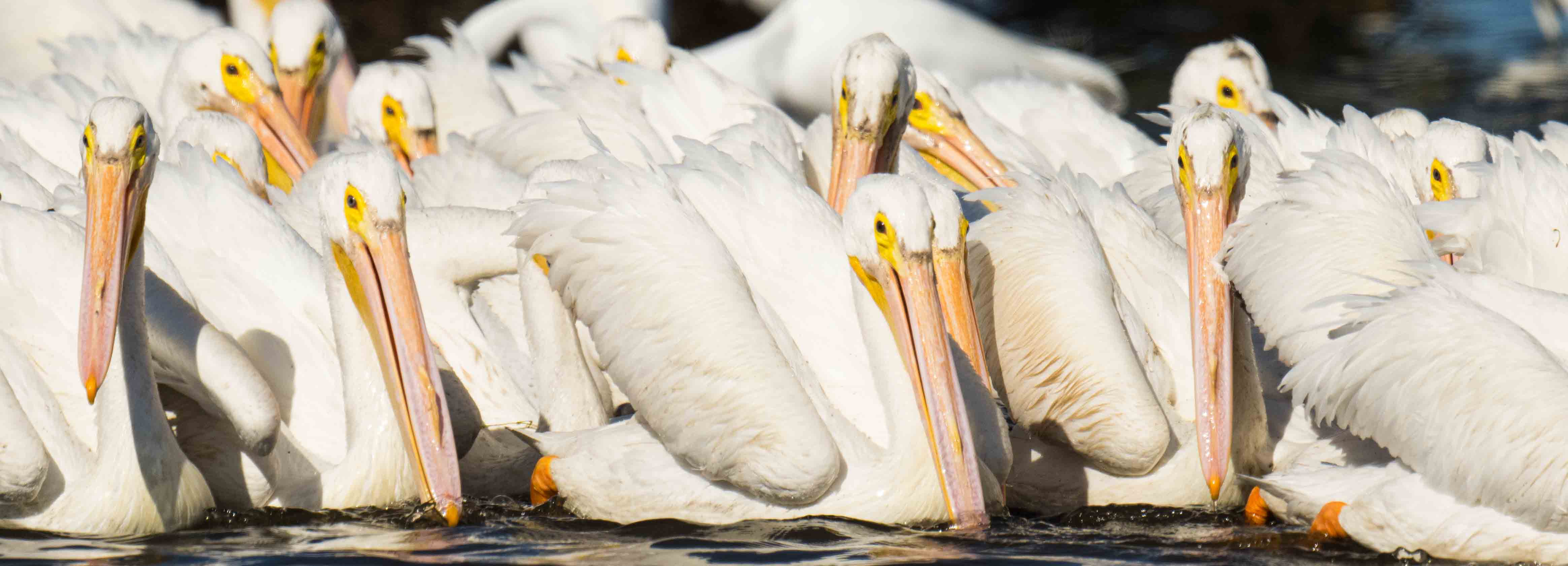
How do White Pelicans catch all those fish? Here’s their secret.

At first glance it looks like chaos — a tangle of wings, beaks and snow-white feathers swirling along the shallows near Florida’s Cape Canaveral.
But what’s unfolding is actually a well choreographed hunt. Scores of American White Pelicans are bunched into a tight flotilla, paddling shoulder-to-shoulder to herd fish into a trap. Their real secret isn’t their size or speed. It’s a level of cooperation you rarely see among birds.

This is a pivotal time of year for these huge, gawky creatures as they migrate from across the Northern Hemisphere to wintering grounds in the southern U.S. and Central America.
Here in the Merritt Island Wildlife Refuge we came across an unusually large flock, gathered in one of the refuge’s sprawling ponds — hundreds of pelicans scooping, chugging, swallowing, in near constant motion.
This is what it looks like close up:
Scenes like this usually take place far from the refuge road that curves through the 140,000 acres of marshlands, waterways and swamps in the refuge an hour east of Orlando.
But on this day, the pelicans, along with an assortment of egrets, spoonbills, avocets, gulls and terns, happened to gather just feet from the roadway. That gave us an exquisite look at their antics, causing an outright traffic jam on the narrow, sandy route that’s usually empty.


Much of the action centered on the pelicans. All that morning, more of the birds would appear on the horizon, approaching in twos and threes from far up in the sky. Then they’d gradually circle their way down to join the party.
An odd combination of grace and awkwardness, the pelicans float effortlessly as they descend, then turn into balky, unsteady creatures as they come hurtling in for their splashdowns.
Here’s a gallery of the birds and their crash landings:


White Pelicans can be found scattered across the U.S. and Central America, both along the East and West coast and across the upper Midwest and Canada where they breed in the spring and summer. Each fall, they migrate south, ending up wintering in a ribbon that extends along waterways from southern California across the Gulf Coast, all across Florida and Central American as far south as Costa Rica.
And unlike the squawking egrets jostling nearby, the pelicans feed with remarkable civility. Once they’ve herded the fish into a snag or shallow pocket, they simply take turns, dipping those enormous bills like oversized ladles. No fighting, no lunging, barely any noise.
Just the quiet efficiency of a group that knows the catch is bigger when everyone rows in the same direction.

This piece, originally posted last year, is republished to coincide with the pelicans’ fall migration. And just below is an animation from the Cornell Lab of Ornithology that shows how the birds move up and down the hemisphere twice a year.


Leave a Reply