
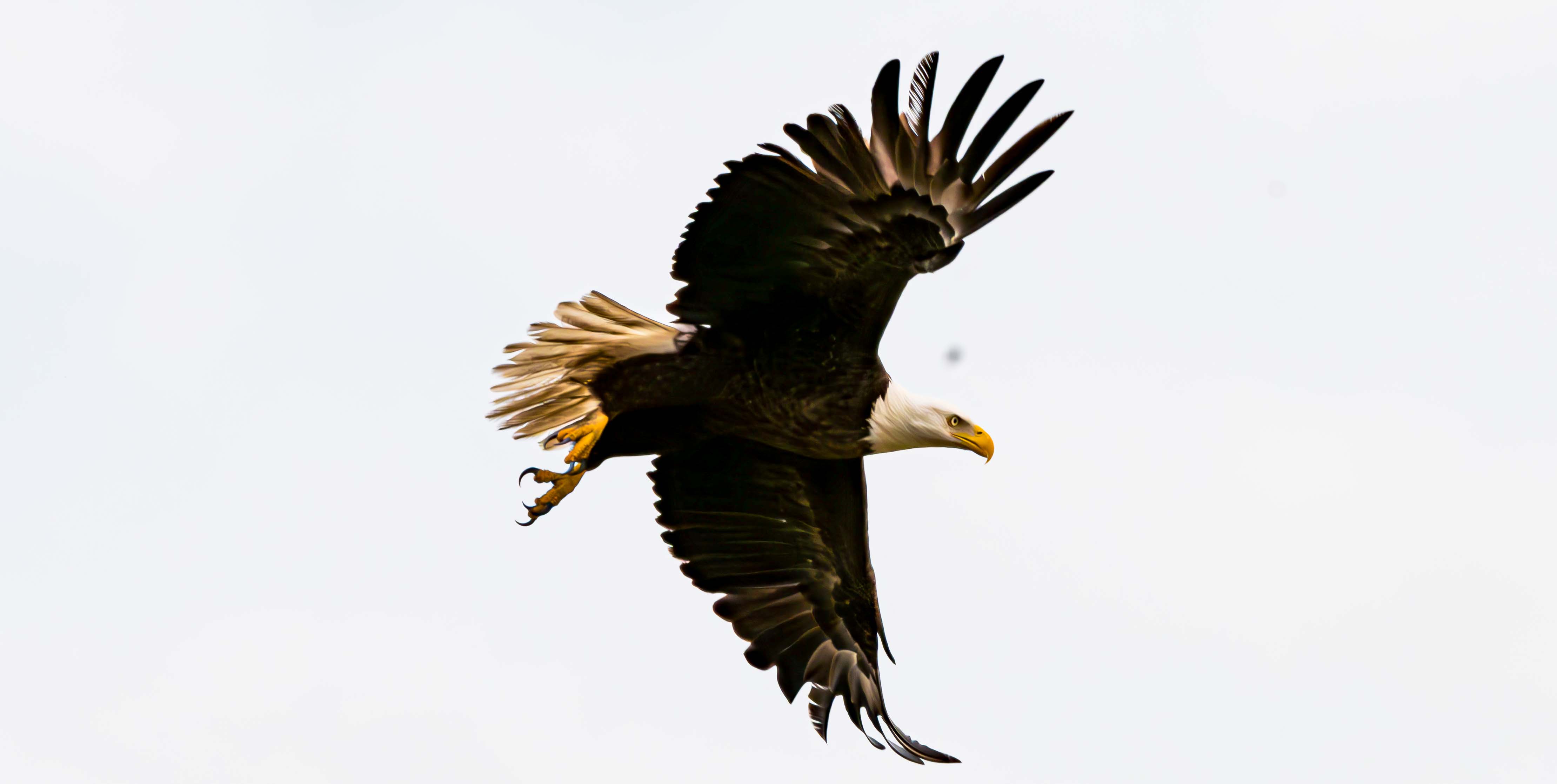
Answer: Long assumed a matter of muscles and wings, flight is turning out to be a far more complex skill in birds, from computer-like instincts to interlocking feathers
By Anders Gyllenhaal
First in a series
The Eastern Meadowlark is gone before I know it, zipping off the instant it sees me and vanishing into the grasslands.
Its flight looks effortless, yet it’s anything but. The takeoff is among the hardest and most intricate moves a bird makes. So much happens at once: It starts with powerful legs pushing off while its wings provide the upward thrust. The Meadowlark’s tail guides its nearly weightless body forward as it folds its legs to create the aerodynamics that birds are all about.

And that takeoff is just the beginning of the astonishing mechanics of flight. The phenomenon has mystified people since the Stone Age and only recently come into focus with incisive new research.

Flight, once thought simply a feature of a bird’s anatomy, is now believed to be driven by computer-like reactions in the bird’s brain, split-second decisions, and feathers that have nerve-like properties that act as a kind of sensor system in flight.

Most frequent questions about birds
This post is the first in a series on the top questions people ask Google and other search engines and chats about birds. And the most frequent of them all is: How do birds fly? (Check out the box at the end of this post for how we came up with a list of 10 questions, along with how the series — What We’re Learning from the Birds — will unfold through the summer and fall.)
The story of flight does indeed start with the physical traits of birds — powerful muscles that work for hours on end; feathers that shift in flight to make the most of aerodynamics; lightweight bones (some actually hollow); and finally, a respiratory system that provides the enormous energy required.
From there the answers get more intriguing. Researchers have found new ways of probing how birds have evolved over the 150 million years since the dinosaur era to become perfect flying machines.

Cracking the Code of Flight

Scientists have set up labs that create wind tunnels so they can watch, video and analyze birds in flight. They’ve dissected the fabric of feathers.
They build models of various species to figure out how they can handle – even thrive in – the constant turbulence that grounds planes and helicopters.
“We have to stop flying in bad weather, so how can a bird be better than anything we can build?” says David Lentink, one of the world’s leading flight researchers. His lab at the University of Groningen in the Netherlands is filled with replicas of birds, recreations of wings and tiny model planes.
What he and a small group of bird flight scientists are finding is that the way birds think, react, and adapt to changing conditions is just as important as their wings and muscles. Flight demands instant decisions, leading researchers to compare a bird’s brain to neural systems powering artificial intelligence.
That’s because the brains of birds, about the size of a walnut, are small compared to other wildlife. But those brains are packed with neurons that enable a speed and level of thinking that’s far more sophisticated than once thought.
“”For a long time having a ‘bird brain’ was considered to be a bad thing: Now it turns out that it should be a compliment,” Vanderbilt University neuroscientist Suzana Herculano-Houzel said in releasing a paper on the surprising brain power of birds. (We’ll go into these discoveries in more depth in the next installment in this series.)

Natural Velcro holds together wings
Those brains, along with powerful muscles and the birds’ impressive respiratory system, are the combination that enable birds to weather the punishing environment they face, especially the majority of North American species that migrate, often long distances, twice a year.
Scientists are now uncovering surprising clues about how it’s done. Part of the answer is how tough birds are – and how well-built they are for flight, including their feathers. One of the most striking recent discoveries is how an interlocking feature – a kind of Velcro – holds feathers together to withstand the pressures of flight. The feathers can instantly unlock when the pressure passes and the connection is no longer needed.

“Birds have this Velcro between their feathers. It exists nowhere else in nature,’’ David Lentink said in a documentary on his lab. “No one knew.’’
Scientists are still learning about the complexity of feathers, which are made of a fibrous substance called keratin comparable to human hair and fingernails. Birds don’t just have one kind; they have as many as nine different versions of feathers that enable all kinds of flight, from take offs to landings, short trips to migration.

What we’re learning from bird flight
It took thousands of years of watching birds for mankind to begin to mimic how they fly. It finally paid off in 1903 for the Wright Brothers, who borrowed much of their experiments from watching birds. “Learning the secret of flight from a bird is like learning magic from a magician,’’ Orville Wright said.

The Wright Brothers are the most famous imitators of birds, but only the beginning. Aeronautics have borrowed from birds ever since, from the shape of fixed wings to the concepts of helicopters gleaned from hummingbirds. Birds have also been the models for developing drones, now used in everything from package deliveries to combat.
And birds have done far more than influence flight. They inspire us in all kinds of ways, in our poetry, art and culture, not to mention untold numbers of symbols from Birdseye vegetables to cars named firebirds, nighthawks, road runners and falcons.
The more scientists study birds, the more there is to learn. Every new revelation uncovers a new layer of complexity. “There are so many things to discover,’’ said Lentink, the reknown bird researcher. “We’ll be busy for years to come.”
How we came up with the key questions about birds
What are the top questions people have about birds?

People have had many of the same questions about birds for generations. But today, the answers are changing — sometimes dramatically — as researchers have gained the tools to track birds in flight, peer into their DNA and use powerful new technologies to watch them in action.
This is the one of the primary reasons we’ve pulled together the most intriguing, age-old questions and delved into the modern avian sciences to answer them. Another reason is that the number of people — old and young — now interested in birds has exploded since the pandemic — and with that come all sorts of questions.
We’ve drawn the top questions from two sources: the most common bird queries people ask search engines like Google and Bing, and the deeper, more open-ended questions increasingly posed to AI systems such as ChatGPT, Claude and Gemini.
These posts explore these questions through the lens of Flying Lessons — looking not only at the astonishing abilities birds possess, but at what we’re learning from them. The answers seek to reach beyond anatomy and instinct into such subjects as intelligence, evolution, navigation, communication, memory and consciousness.
Taken together, we think ongoing discoveries reveal something important: The more we learn about birds, the more mysterious and remarkable we realize they are.
We’d love to hear your own questions — and your thoughts on these answers — as we explore mysteries and latest revelations about birds. Here are some of the questions we’ll be answering in the coming months (with links to the ones we’ve finished.)
How do birds fly the way they do?
What goes on inside a bird’s head? Do birds have consciousness?
Why are birds so colorful — matched by no other segment of nature?
Why do they sing — especially at dawn?
How well are birds adapting to the rapidly changing environment — and what does this mean for their future?
What can be done to help birds in an era of change, pressure on populations and powerful new conservation tools?


Leave a Reply